
Men's Health & Longevity Coaching
Performance. Vitality. Healthy Aging.
Men's Health and Longevity After 40: What Really Changes, What It Costs, and How Dr. John Spencer Ellis Helps Men Fix It
Quick answer: After age 40, most men lose muscle, aerobic capacity, and hormonal efficiency at a slow and steady rate. It does not feel like much year to year. It adds up to a lot by 50. The decline is measurable, predictable, and — with the right structure — largely reversible. What men need is not more information. It is the correct sequence, applied consistently.
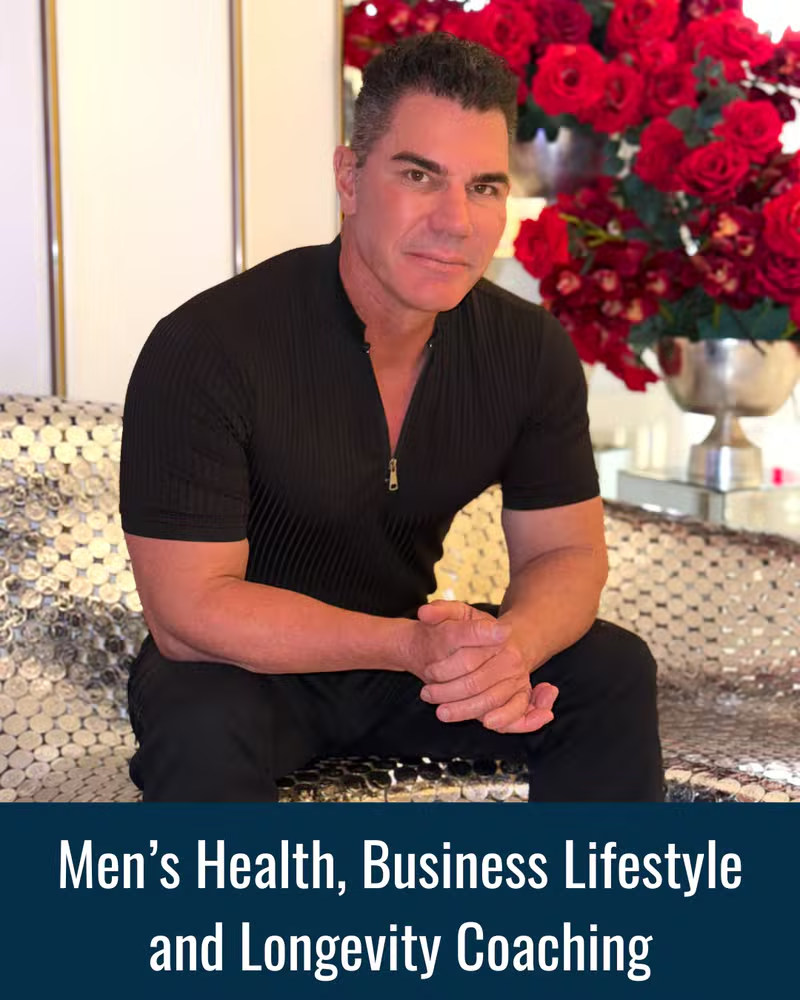
Here is the part almost nobody explains clearly: what you feel emotionally and what is happening biologically are the same event. The flat mood, the shorter fuse, the softer midsection, the tired face in the mirror are not separate problems. They are one system losing its structure.
This article covers what changes after 40, what accelerates after 50 without intervention, why a longevity protocol also improves how you look, and how Dr. John Spencer Ellis' Men's Health and Longevity Coaching Program addresses all of it together.
The Emotional Reality: Why Men Over 40 Feel Like a Different Person
Ask a man in his mid-forties what changed and he rarely says "my VO2 max dropped." He says he feels flat. He is tired by 3 p.m. Photos surprise him. He still wants things, but the want feels quieter than it used to.
That experience is real, and it is not self-pity. It is what declining physical capacity feels like from the inside. Energy, drive, confidence, and mood all run on the same machinery: sleep quality, muscle mass, cardiovascular fitness, blood sugar control, and hormonal balance. When the machinery slips, a man feels it long before he sees a number.
Most men respond by adjusting expectations instead of investigating causes. That one decision turns a fixable decade into a permanent one.
The Logic: Decline After 40 Is a System Problem, Not a Willpower Problem
Men are told to "try harder." The logic does not hold up. A man at 45 is not less disciplined than he was at 25. He has less recovery capacity, less anabolic signaling, more career load, less sleep, and less margin. Applying a 25-year-old's approach to a 45-year-old's biology produces frustration, not results.
The correct logic is sequencing. Sleep and stress physiology come first, because nothing else holds without them. Then structure and training. Then nutrition and body composition. Then bloodwork-guided refinement. Men who follow that order improve. Men who skip step one quit by week four and blame themselves.
The Numbers: What Research Shows About Men's Health After 40
The data is consistent across decades of study.
- Testosterone declines roughly 1% per year in men from around age 30 to 40 onward. Over twenty years, that is meaningful, not trivial.
- Muscle mass falls about 3% to 5% per decade after age 30. Harvard Health notes most men lose roughly 30% of their muscle mass across a lifetime.
- Strength declines faster than size — research shows strength is lost two to five times faster than mass, and strength loss predicts disability and death more consistently than muscle loss alone.
- VO2 max, your aerobic engine, drops about 10% per decade in sedentary adults starting in the fourth decade of life.
- Fitness is one of the strongest survival predictors known. A Cleveland Clinic study of more than 122,000 patients in JAMA Network Open found fitness inversely associated with all-cause mortality, with no upper limit where more fitness stopped helping.
- Sarcopenia carries real consequences. Research cited by Harvard found people with sarcopenia had 2.3 times the risk of low-trauma fracture.
- Men use preventive care less. CDC data shows women are about 33% more likely to visit a doctor, with roughly double the rate of preventive visits.
- The gap shows up in lifespan. U.S. life expectancy in 2024 was about 76.5 years for men versus 81.4 for women — a gap of roughly five years.
What Changes After 50 Without Proper Intervention
After 50, the slope steepens. Muscle loss can accelerate toward 1% to 2% per year. Aerobic capacity keeps falling roughly 10% per decade, so a man already low at 45 nears the threshold where ordinary activity feels hard. Visceral fat rises, insulin sensitivity worsens, sleep degrades, and recovery takes longer.
Compounding is what matters. A 5% loss at 45 is invisible. The same 5% stacked five times is the difference between a man who travels, trains, and works at full capacity at 65 and a man who is managing conditions.
The reverse is equally true. Aerobic capacity is highly trainable — sedentary adults commonly improve VO2 max 15% to 25% with moderate structured training. Muscle responds to resistance training at every age studied. The decline is not fixed. It is simply unattended.
Why a Longevity Protocol Also Changes How You Look — and How You Feel About Yourself
This is the part men are embarrassed to say out loud, so let's say it plainly: appearance matters, and it is not vanity.
Body composition, skin quality, posture, and how you carry yourself are outputs of the same systems longevity work targets. Lower visceral fat sharpens the face and waistline. Better sleep improves skin. Resistance training restores shoulder width, posture, and the physical presence men lose in their forties. Stable blood sugar shows up in energy and complexion.
That is why aesthetics and confidence move together. Male confidence is evidence-based — it comes from demonstrated progress, not affirmations. A waist that drops, a lift that goes up, bloodwork that improves, a reflection that matches the man you still feel like inside: that is the evidence. Confidence is the sum of the data points.
How Dr. John Spencer Ellis' Men's Health and Longevity Program Works
Dr. John Spencer Ellis is a Las Vegas–based performance and life optimization coach who has worked in health, fitness, and human performance since 1992. His Health, Longevity and Aesthetic Optimization program for men 40+ is a 90-day, fully personalized engagement built around the exact sequence described above.
How it works:
- Comprehensive intake and assessment — health status, training history, sleep, stress load, lifestyle, and goals.
- Bloodwork guidance — personalized help interpreting your labs with your physician, so decisions rest on data.
- A custom action plan — training, nutrition, sleep, stress physiology, recovery, and lifestyle design as one integrated protocol.
- Twelve weekly one-on-one sessions with John, plus extensive video coaching modules.
- Ongoing accountability — weekly contact raises consistency, and consistency predicts results.
Why it works: it is sequenced instead of scattered, structured instead of motivational, measured instead of assumed, and integrated instead of split across four disconnected specialists. John Spencer Ellis' guiding principle — Experience Over Theory. Structure Over Motivation. — is the operating logic of the program.
Take action: register for a free initial evaluation at
https://johnspencerellis.com/health-longevity-aesthetic-optimization-for-men-40/.
Questions Men Ask Most About Health and Longevity After 40
- Is it too late to start at 50 or 60? No. Muscle and aerobic capacity respond to training at every age studied. Starting later means less margin, not a closed door.
- How fast will I see results? Sleep usually improves in four to six weeks. Strength and body composition show visible change in eight to twelve weeks. Many blood markers shift within a single quarter.
- Should I get my testosterone tested? Get comprehensive bloodwork with a physician — hormonal, metabolic, inflammatory, and lipid markers. One number in isolation is rarely useful.
- Is cardio or strength training more important after 40? Both. Strength preserves muscle, metabolic health, and independence. Aerobic work protects VO2 max, one of the strongest longevity predictors measured.
- Why do I look older even though my weight is the same? Body composition changed underneath a stable scale number — muscle down, visceral fat up. Track waist and strength, not weight alone.
- Do I need a coach if I already know what to do? Most men do not have an information gap. They have a consistency gap. Structure and accountability are what close it.
- Is this medical treatment? No. Coaching is educational and works alongside your physician, not instead of one.
Top Searched Related Phrases
men's health after 40 · men's longevity coach · how to increase testosterone naturally after 40 · muscle loss after 50 in men · VO2 max and longevity · biological age vs chronological age · best exercise for men over 50 · how to lose belly fat after 40 men · hormone optimization for men · healthspan vs lifespan · men's health coach Las Vegas · anti-aging for men over 40 · rebuild confidence after 40 · look younger after 50 men · longevity protocol for men · Dr. John Spencer Ellis coaching
About the Author
Dr. John Spencer Ellis is an internationally recognized performance and life optimization coach based in Las Vegas, Nevada, and originally from Orange County, California. An award-winning health expert and entrepreneur since 1992, he holds two bachelor's degrees in business administration and health science, an MBA, a doctorate, and fifteen professional certifications spanning personal training, nutrition, clinical hypnotherapy, somatic studies, sports psychology, sleep science, and neurolinguistics. He has been inducted into the Personal Trainer Hall of Fame, is recognized among the Top 100 Most Influential Personal Trainers of All Time, and is a four-time Amazon #1 bestselling author. His work has been featured across ABC, NBC, CBS, FOX, ESPN, and Bravo.
Learn more: https://johnspencerellis.com
Escape the Rat Race Coaching Program:
https://johnspencerellis.com/pick-my-brain/mens-lifestyle-business-and-escape-the-rat-race-coach/
Media coverage:
- USA Today — https://www.usatoday.com/press-release/story/35880/dr-john-spencer-ellis-launches-mens-health-and-longevity-coaching-program-for-men-over-40/
- AP News — https://apnews.com/press-release/access-newswire/press-release-608b6a906a37f8b2fad8fa54b4e81c3f
- Access Newswire — https://www.accessnewswire.com/newsroom/en/healthcare-and-pharmaceutical/dr.-john-spencer-ellis-launches-mens-longevity-coaching-system-drawin-1182869
Sources: Harvard Health Publishing (muscle mass preservation); JAMA Network Open — Mandsager et al., cardiorespiratory fitness and mortality; Journal of Cachexia, Sarcopenia and Muscle — sarcopenia and dynapenia quantitative review; Centers for Disease Control and Prevention (life expectancy and preventive care utilization); Medicine & Science in Sports & Exercise — VO2 max decline with age.